


- What BIOVER SYSTEM is and how it works
- When to choose BIOVER SYSTEM
- Key benefits of BIOVER SYSTEM
- How BIOVER SYSTEM is applied: the essential procedure
- Design criteria and indicative application rates
- What BIOVER SYSTEM can do and what it does not replace
- BIOVER SYSTEM on complex slopes: two applications
- Full Service Green Solutions: expertise and experience for tailored solutions
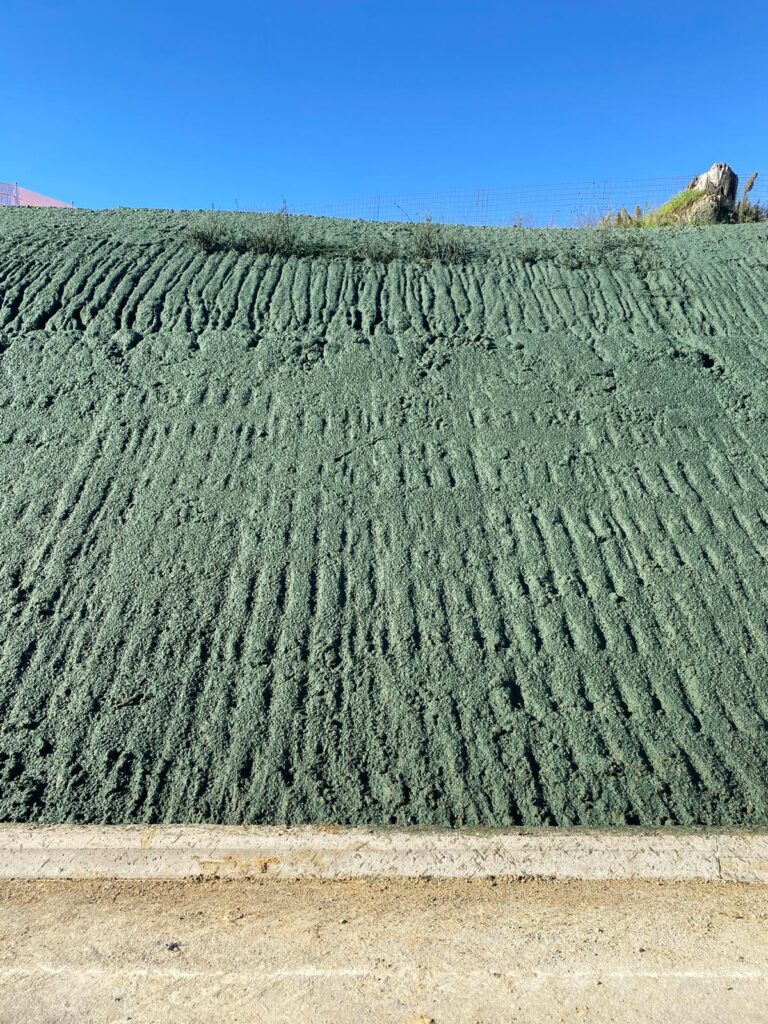
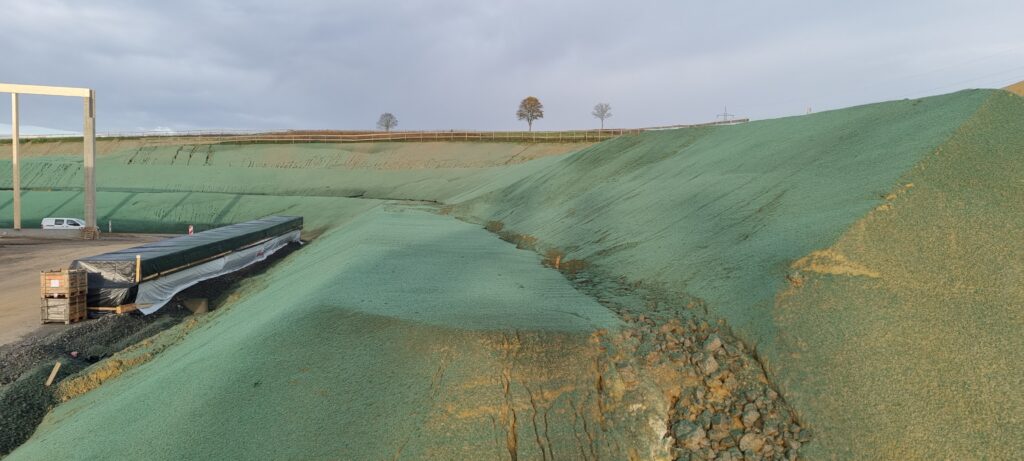
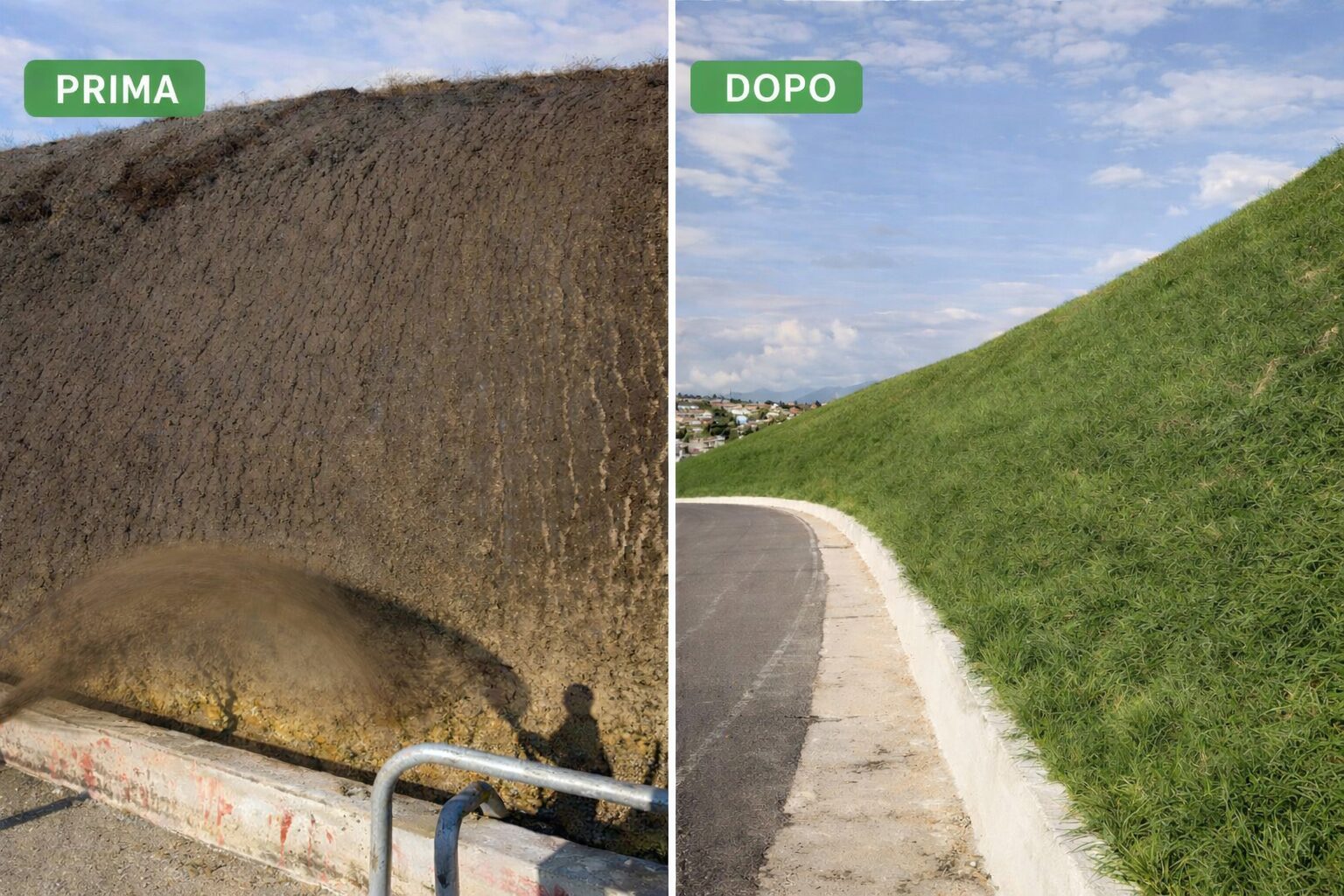
BIOVER SYSTEM is an integrated system for the technical revegetation of slopes and degraded land where two challenges occur simultaneously: the substrate provides unfavorable conditions for vegetation, and the surface is exposed to erosion before roots can develop their protective function. The system combines HYDROTER and HYDROMAT MFL, applied using a hydroseeder together with the agronomic components specified for the site.
HYDROTER acts on the substrate. It is a fully plant-based product containing wood fibers, humic substances, amino acids, biostimulants and mycorrhizae derived from renewable sources. In soils with low organic matter content and limited biological activity, it provides components that help initiate nutrient cycling, support root development and create more favorable conditions for vegetation establishment.
HYDROMAT MFL protects the surface. It is a bonded fiber matrix that adheres to the irregularities of the ground as it dries, forming a flexible cover. The matrix reduces raindrop impact, limits the loss of seeds and fine soil particles, and creates small spaces that retain water and promote oxygen exchange.
The two technologies therefore perform different, complementary functions: improving the agronomic conditions of the surface layer and providing erosion protection in direct contact with the slope.

BIOVER SYSTEM is suitable when conventional hydroseeding would not provide sufficient protection, or when topsoil placement is costly, unstable or logistically difficult. Typical applications include:
- road, railway and infrastructure slopes with poor, compacted or readily erodible soil;
- embankments, cuttings, quarries, mines, landfills and degraded areas requiring restoration;
- steep or irregular slopes, including surfaces fitted with three-dimensional geomats or wire mesh, where close ground contact is required;
- sites with restricted access where topsoil handling and the use of heavy machinery need to be reduced;
- projects where the risk of washout is greatest during the initial germination and establishment stages.
However, the choice cannot be based on slope gradient alone. Slope length, soil texture and compaction, surface roughness, aspect, rainfall patterns and water entering from upslope all influence site behavior and must be assessed together.
Technical and site benefits
- Combines substrate improvement and surface erosion protection within a single project.
- Is hydraulically applied and adapts to irregular or difficult-to-access surfaces.
- Reduces earthmoving and can simplify scheduling, transport and site operations compared with topsoil placement.
- Provides continuous coverage, provided that application rates and distribution are appropriate for the actual slope surface area.
Agronomic benefits
- Supports biological activity in depleted substrates and promotes root development.
- Retains moisture in the germination zone and reduces the risk of seed loss during the early stages.
- Allows seed mixtures, nutrients and soil amendments to be selected according to the vegetation objectives and soil analysis results.
Environmental benefits
- Uses plant-based, renewable components to improve the substrate.
- Can reduce the removal of agricultural topsoil, transport requirements and emissions associated with placing large volumes of topsoil.
- Supports the revegetation of degraded surfaces through an intervention tailored to actual site conditions.

Step 1 – Assessing the slope and substrate
Before specifying the mixture, the assessment covers slope stability, gradient, height and length, soil characteristics, pH, organic matter, salinity, infiltration capacity, surface water and climatic conditions. An agronomic assessment determines whether fertilizers, soil amendments or pH-adjusting agents are required. Deep erosion channels, loose material, standing water and concentrated inflows from upslope must be addressed before application.
Step 2 – Specifying the mixture and application strategy
The quantities of HYDROTER and HYDROMAT MFL, the seed mixture and any nutrients are specified according to soil conditions, erosion risk, application season and vegetation objectives. On highly irregular surfaces, the actual area to be covered must be considered, as it exceeds the area shown in plan view. The application method – single or multiple passes, hydroseeder cannon, hose application or aerial application – also depends on site accessibility and geometry.
Step 3 – Application and monitoring
The hydroseeder must have agitation and pumping systems suitable for mixtures with a high fiber content. Loading sequence, mixing time and distribution must ensure a uniform spray, avoiding untreated areas behind surface irregularities, stones or mesh. The ground must not be frozen, saturated or subject to flowing water, and a suitable weather window is required to allow the matrix to adhere and dry. After the first rainfall events, inspections assess coverage continuity, any erosion channels and vegetation response; irrigation, nutrient applications or local repairs are scheduled only where necessary.
Design criteria and indicative application rates
Application rates are not standard recipes. For HYDROTER, the technical documentation provides the following preliminary guidance, based on soil organic matter content and slope gradient:
| Soil organic matter | Slope gradient | HYDROTER |
| 1.5% to < 5% | ≤ 4H:1V | 400 g/m² |
| 0.75% to < 1.5% | > 4H:1V and ≤ 3H:1V | 500 g/m² |
| < 0.75% | > 3H:1V and ≤ 2H:1V | 600 g/m² |
These values are indicative. Soil analysis and consultation of the latest technical data sheets are recommended before finalizing the design.
For HYDROMAT MFL, the average reference application rate is approximately 400 g/m². The actual quantity must ensure continuous coverage and be adjusted according to slope gradient, surface irregularities and actual surface area. Seed, water, fertilizers, biostimulants and soil amendments should not be specified at fixed rates: plant species, seed lot quality, season, water availability and project objectives all influence the final formulation.
BIOVER SYSTEM improves growing conditions on poor substrates and reduces erosion caused by raindrop impact and sheet runoff during the most vulnerable vegetation establishment stage. However, it is not a geotechnical stabilization measure: it does not stabilize slopes affected by landslides, slipping, settlement or other deep-seated instability. Nor does it replace drainage and water management measures in channels, drainage hollows or locations subject to concentrated flows.

Along a forest road in the province of Udine, BIOVER SYSTEM was spray-applied to the slopes beside the carriageway. The intervention aimed to protect exposed soil from washout and create more favorable conditions for vegetation establishment, while limiting earthmoving in an environmentally sensitive setting.
At San Severino Lucano, the steep gradient, irregular slope profile and restricted access required helicopter application. This case demonstrates the system’s operational flexibility, while also highlighting the need for precise planning of the formulation, loading, distribution uniformity and weather window.

With over forty years of experience in erosion control, hydroseeding and revegetation, Full Service Green Solutions supports designers, contractors and public bodies in selecting and specifying the system. The assessment considers slope geometry and photographs, soil analysis, surface water, application season, vegetation objectives, water availability and site accessibility.
These inputs determine component application rates, species selection, any agronomic amendments, the application method and the monitoring plan. Where the available information is insufficient, a site visit or further agronomic, geotechnical and hydraulic investigations may be required. BIOVER SYSTEM is therefore a technical solution tailored to actual site conditions, rather than a fixed formulation.
To assess the use of BIOVER SYSTEM on a slope, embankment or degraded area, contact Full Service Green Solutions for a preliminary technical discussion and a site-specific application proposal.